
Revolutionizing IP Valuation with market-proven data technology
Turn manual patent valuation into a transparent, auditable, and repeatable workflow — in seconds, at per-patent precision, and at portfolio scale.
Illustrative figures. Every run discloses its full parameter set.
Why patent valuation is hard
There is no liquid market with observable prices and traditional expert opinions are slow, costly, and difficult to reproduce, which limits continuous monitoring and makes smaller mandates uneconomical.
Patents differ by statutory term, jurisdictional footprint, examination history, and their causal link to products, which means the economic weight of each family varies widely and portfolio averages conceal where value actually concentrates.
In practice, a minority of families typically drives the majority of value, and without per-patent modeling, those value drivers remain obscured.
The Kairos difference
Kairos delivers a data-first, automated execution of the Relief-from-Royalty method at per-patent precision, which enables continuous valuations, smaller portfolios, and ongoing mandates to be handled economically and with full auditability.
Every step is traceable end to end, with complete parameter disclosure and auditable inputs, so that auditors, regulators, and examiners can verify methods and reproduce outcomes.
The platform produces repeatable, portfolio-wide valuations that can be run monthly or on demand, turning one-off projects into ongoing, defensible workflows.
How it works: three-stage pipeline
Strength
The system validates technological and legal robustness using transparent signals such as forward citations, claim scope, and jurisdictional breadth, while algorithmically excluding lapsed or non-qualifying rights so they cannot inflate balance sheet figures.
Mapping
Each patent family is linked to operating segment revenues via semantic mapping with standardized industry classifications, after which industry-standard royalty rates are applied and value is allocated within segments by relative patent strength.
Prognosis
A risk-adjusted, term-congruent DCF is computed per patent using up-to-date market inputs, with a separate IP-specific risk premium and full sensitivity analysis that clarifies how assumptions influence the valuation corridor.
What you get
Instant PDF reports aligned with IFRS and OECD that provide either a portfolio overview with clear analysis visuals and sensitivity ranges or a per-patent breakdown with individual risk factors, quality scores, and value attribution.
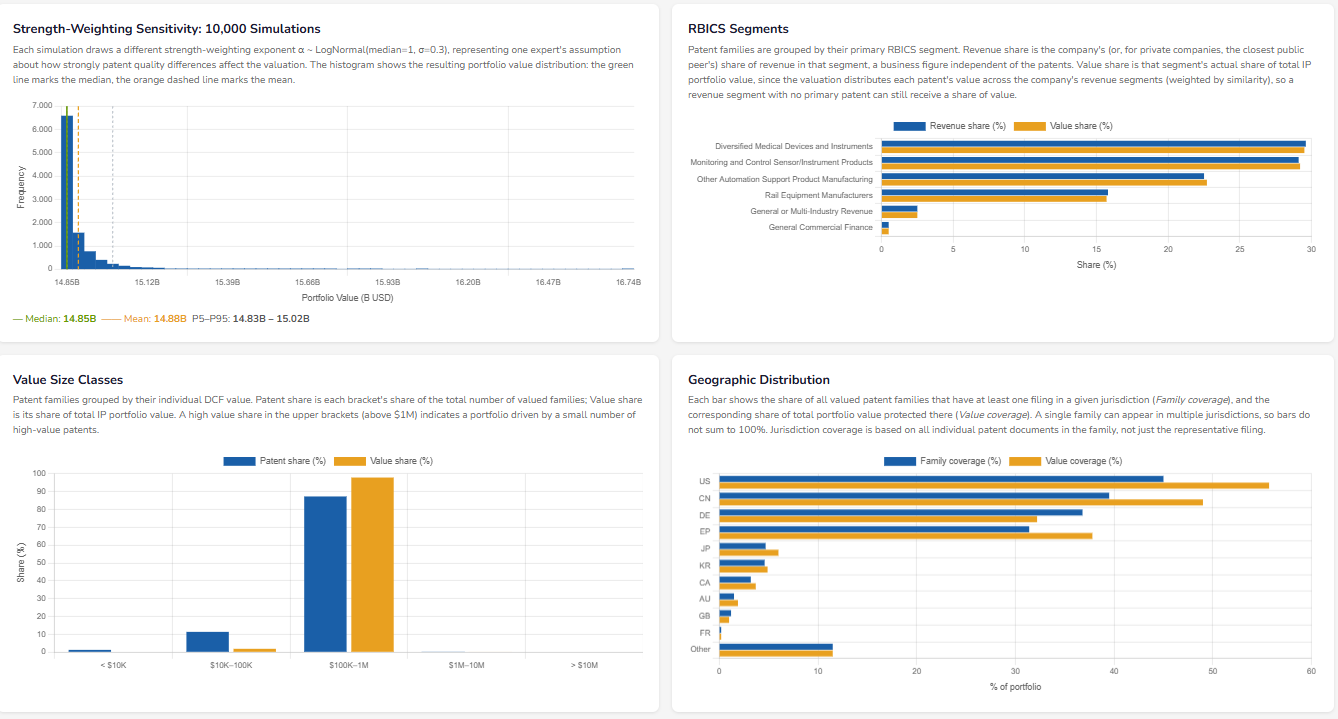
Full parameter transparency with best, base, and worst-case scenarios, plus Monte Carlo strength-weighting to quantify uncertainty, which together produce a defensible audit trail.
APIs and data feeds that integrate directly into finance, tax, transfer pricing, and business intelligence systems, making valuations operational in daily workflows.
Example
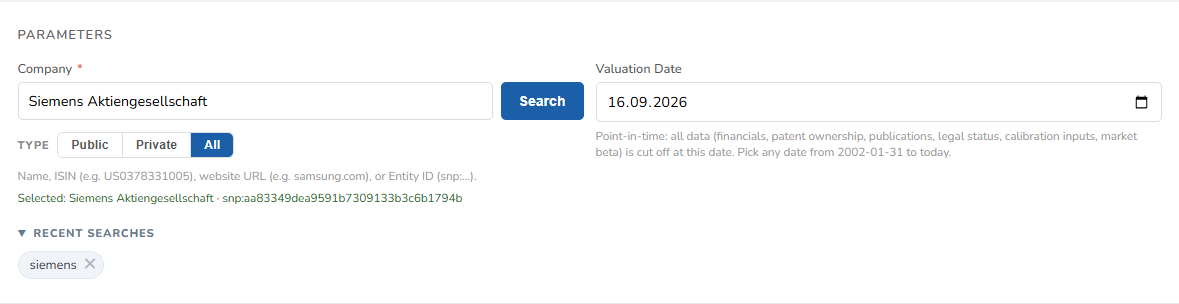
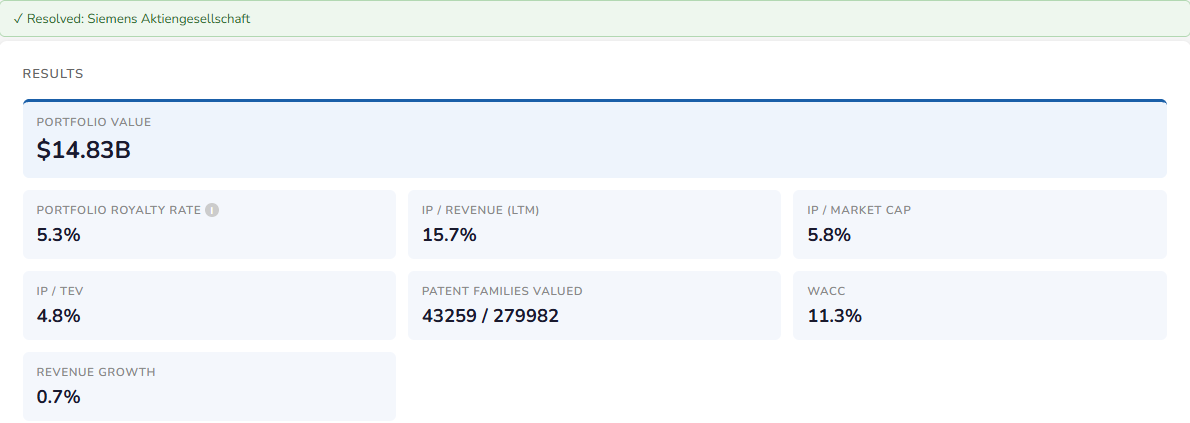
Representative portfolio runs consistently reveal that a small fraction of patent families carries the majority of value, and the output identifies the exact families and jurisdictions responsible, which enables focused decisions on renewals, monetization, or divestment while exposing expiring or non-mapped assets.
Applications
M&A and diligence
Verify patent substance against the equity story, surface red flags such as paper patents or imminent expiries, and quantify valuation corridors with sensitivity bands.
Company valuation, PPA, and impairment
Automate intangible allocation after transactions and support recurring impairment tests with per-asset figures and a complete audit trail.
Transfer pricing and tax
Produce Arm's Length-compliant documentation with transparent Relief-from-Royalty execution that stands up in audits across jurisdictions.
Debt and collateral
Enable IP-backed lending by valuing patent portfolios as verifiable collateral and support continuous covenant monitoring over the loan's term.
Continuous IP monitoring
Provide monthly visibility into core patent value changes and innovation strength, supporting board-level governance and risk management.
Capital markets and IPO preparation
Quantify innovation with empirical strength indicators that integrate into the equity story and prospectus materials.
CFO advisory and innovation controlling
Track ROI on R&D, optimize portfolio costs, and identify non-core but valuable rights for sale or licensing.
Where Kairos fits - and where it does not
The platform complements deep-dive expert opinions by providing a reproducible, portfolio-wide baseline that is suitable for financial statements; it is not a generic scoring tool and focuses specifically on producing monetary values with auditable derivation.
The methodology is transparent and aligned with IFRS 3 and IAS 38, with machine learning applied to patent quality measurement rather than to the value determination itself, and the scope is intentionally limited to patents while other IP classes require complementary work.
Who is this for?
Why partner with Quant IP
Quant IP combines a proven data foundation widely used in institutional finance with an integrated stack that includes data feeds and APIs, thematic analytics, and the Kairos valuation engine, which together deliver material time and cost savings in advisory workflows and open the mid-market with recurring mandates.
Schedule a demo

Frequently asked questions
How does Kairos ensure compliance with the Arm's Length Principle for transfer pricing?+
Kairos applies the established Relief‑from‑Royalty method and connects each patent family to the relevant operating segment through semantic mapping based on standardized industry classifications, then applies empirically derived royalty rates so that the resulting valuations are consistent, auditable, and aligned with Arm's Length requirements across jurisdictions and tax regimes.
Are the reports fully auditable and suitable for annual financial statement audits?+
Yes; every model input, parameter, and point‑in‑time data snapshot is transparently documented and versioned so that auditors can trace conclusions back to primary sources, which provides a complete, reproducible audit trail suitable for annual financial statements and regulatory reviews in multiple regions.
How does the model handle discretionary judgment in assessing patent quality?+
Discretionary judgment is minimized by the Quant IP Quality Score, which evaluates transparent indicators such as forward citations, claim scope, and jurisdictional grant probabilities, thereby translating complex legal and technological signals into a consistent machine‑learned measure that can be reviewed and explained to stakeholders.
How is the economic useful life of intangible assets reflected in the cash flow model?+
The engine assigns each individual patent a discounting horizon that exactly matches its remaining statutory term, which means value decay is modeled on a term‑congruent basis rather than through a single portfolio‑wide assumption that can distort results upward or downward.
Are general market risks and patent‑specific risks conflated in discounting?+
No; the model clearly separates company‑level capital costs captured by the WACC from a dedicated IP‑specific risk premium that quantifies exposures such as technological obsolescence and legal invalidation, which ensures that general market risk and patent‑specific risk are not mixed.
What happens when specific plan data or company parameters are missing?+
The system follows a strict input hierarchy in which client‑provided values take precedence, followed by current analyst consensus and, if necessary, long‑term historical averages, thereby preserving valuation continuity even when certain parameters are temporarily unavailable.
How are expired or legally worthless rights treated within the portfolio?+
Patents that have lapsed, lack a determinable remaining term, or fail legal qualification are automatically excluded at a present value of zero, which protects against inflated figures and prevents balance sheet overstatements while clarifying where real economic value resides.
Does Kairos value other intellectual property besides patents?+
No; Kairos is purpose‑built for patents and does not cover trademarks, designs, copyrights, software rights, trade secrets, or customer‑relationship intangibles, so those asset classes require complementary valuation work to produce a complete intangible view.
How suitable is the solution for M&A due diligence in cross‑border contexts?+
Kairos is highly suitable because it reveals statistically grounded patent substance, highlights red flags such as non‑mapped “paper patents” or families approaching expiry, and produces sensitivity bands that help buyers and sellers compare valuation corridors across scenarios and jurisdictions.
Can client‑specific management plan data feed into the valuation?+
Yes; when clients provide revenue forecasts, WACC assumptions, or scenario inputs, the system prioritizes those values ahead of defaults so that the resulting valuation reflects current management plans while remaining fully transparent and auditable for internal and external reviewers.
How is revenue allocated methodically across diversified technology conglomerates?+
The platform uses semantic similarity between patent text and detailed operating segment descriptions to assign each family causally to the revenues it protects, and then distributes value within a segment according to relative patent strength rather than applying uniform portfolio‑level assumptions, which keeps attribution objective.
Does the software replace the auditor or tax consultant in the process?+
No; the software automates data acquisition and complex modeling so that audit, tax, and valuation professionals can focus on interpretation, scenario design, and client leadership, thereby increasing throughput and consistency without displacing professional judgment or responsibility.
Can the system be used for ongoing risk management and regular impairment testing?+
Yes; continuous valuations and monthly signal updates make value changes in core patents immediately visible, which supports board‑level governance, covenant monitoring, and recurring impairment testing with defensible per‑asset figures suitable for multi‑jurisdictional reporting.
Why is this valuation architecture strategically decisive for modern advisory firms?+
Combining global data depth with automation converts resource‑intensive one‑off mandates into scalable, repeatable workflows, opening mid‑market opportunities, reducing cycle times, and creating recurring revenue streams in impairment testing, transfer pricing, and transaction support across regions.